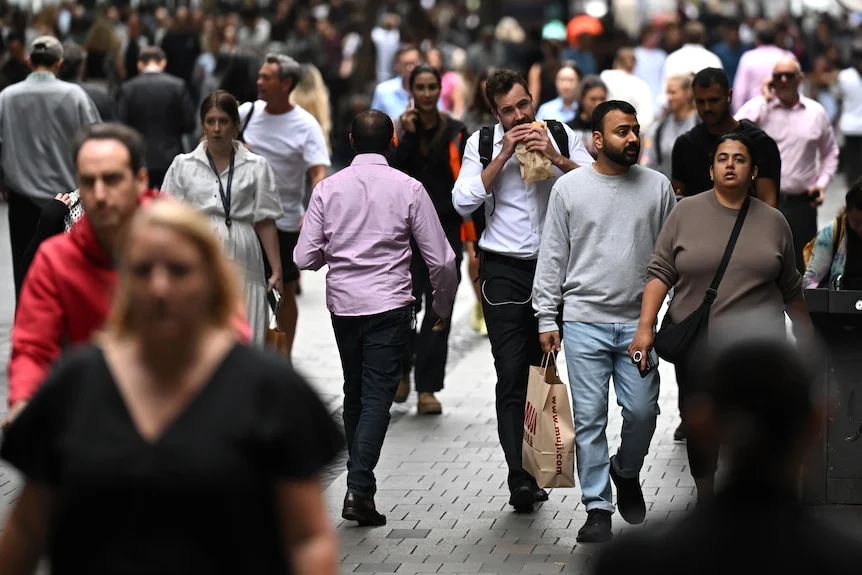
Plenty of Australians already feel like they're in a recession. The official numbers say otherwise, and the gap between those two readings is the real story. Hundreds of people have shared their experiences with the ABC, and the picture is consistent: small businesses worry about losing customers and staff, and home owners worry about paying the bills and putting food on the table.
Australia has so far avoided a technical recession. Still, many of the warning signs that usually come before one are getting harder to dismiss. The unemployment rate has climbed to 4.9 per cent, its highest level of the post-pandemic period, and a Roy Morgan poll shows consumer confidence at its lowest in seven months.
Job cuts are piling up. Bunnings, Canva, NAB, Bendigo Bank, ING and Qantas are among the major businesses that have cut thousands of jobs in recent months. Artificial intelligence, offshoring, restructuring and slowing economic activity explain much of it. Meanwhile, living costs keep rising faster than many household budgets can absorb.
Whether all of that adds up to a recession depends on how you define one.
Two definitions, two answers
Broadly, a recession is a period when the economy stops growing and starts shrinking. The most common test is the "technical recession": two consecutive quarters of negative growth in gross domestic product, which measures the total value of goods and services the country produces. When that happens, businesses earn less, consumers pull back, and unemployment tends to rise as firms freeze hiring or cut staff.
By that test, Australia isn't in one. The economy is still expanding, just slowly. GDP rose 0.4 per cent in the June quarter and was up 2.1 per cent over the year. That's hardly a boom, but it isn't contraction either.
Ben May, director of global macro research at Oxford Economics, says some conditions that have historically preceded recessions are visible in economies around the world today. "These features are visible in elevated energy prices, rising bond yields, and the AI boom," Mr May said. "Still, compared with the 1970s and 1980s, economies are better positioned to weather shocks. It would take a further escalation in these or a sharp reversal of the AI boom to push the world economy into recession; a possible but not inevitable outcome."
That's a measured read, and it's the right one. But "possible but not inevitable" offers little comfort to a household already counting groceries.
So Australia isn't in an official recession, but economists have other yardsticks. The one that fits the public mood best is the "per capita recession". Years of rising prices, heavier mortgage repayments and wages that haven't kept up have eroded living standards, even while the overall economy keeps growing. The total pie is bigger, but each person's slice is smaller.
Abhijit Surya, senior APAC economist at Capital Economics, says Australia hasn't entered a per capita recession yet. Official data show real GDP per person slipped slightly in the March quarter before edging higher in the June quarter. "However, that's far from a stellar outcome," Mr Surya said. "With the economy set to slow markedly, we wouldn't rule out the possibility that Australia enters a per capita recession over the next few quarters."
Here's the thing: the statistics can say "not yet" while households say "already". Reserve Bank governor Michele Bullock has acknowledged the disconnect. After the central bank lifted the cash rate to 4.85 per cent, she said conditions for many households were "going to make people feel like it's a recession because they feel poorer."
So the economy may still be growing "on paper". Around kitchen tables and across business counters, plenty of Australians tell a very different story.
Every dollar counts
Albury resident Nicole Thurgate is living that gap. "I feel like I'm in a recession and it definitely feels like we're going backwards," Ms Thurgate said.
"You just feel like it's never going to end, there's just so little hope."
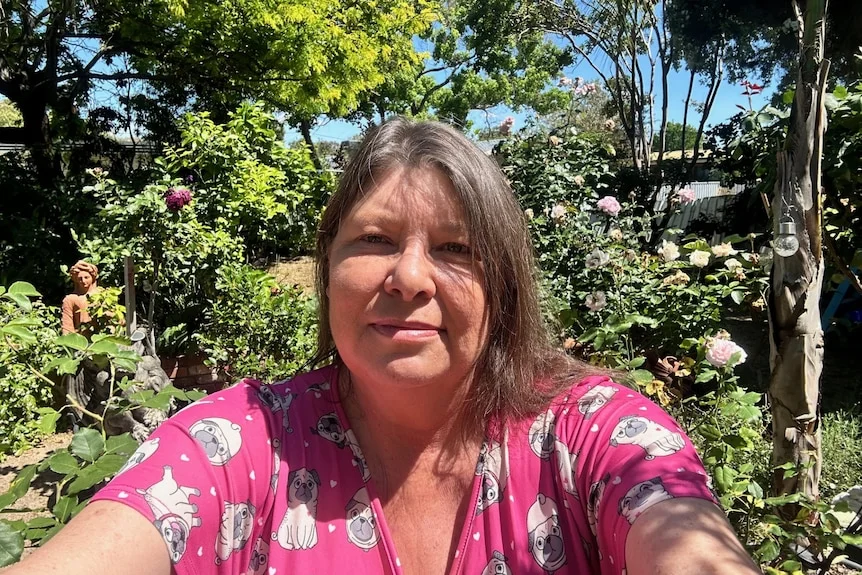
The 57-year-old says it was around the third interest rate rise of 2026 that rising mortgage repayments and living costs together became impossible to ignore. Since then, she has cut almost every discretionary expense she can think of. Her car is off the road because she can't afford repairs. She has sold personal belongings, including her mother's jewellery and a perfume collection, and has stopped buying takeaway and red meat altogether.
"It's not just giving up luxuries here," she said. "[It's] basic things, right down to the kind of tea bag I'm buying, it's become every cent. So when you read something that says people just need to give up luxuries, I don't have any more left."
After paying the bills, Ms Thurgate is often left with just $50 to $60 a fortnight for groceries. That arithmetic makes advice to cut back sound hollow.
Her worries don't stop at the supermarket. Hundreds of positions have been made redundant at her workplace in the past year, and more cuts have been flagged in recent meetings. "I am terrified because if that happened, I don't know what I would do," she said.
"While I do have fantastic experience, let's be realistic: when it comes to applying for jobs, 57-year-old women aren't that popular."
Those kitchen-table decisions are rippling out to small business. Andrew Bianco runs Ragtime Tavern in Preston, Victoria. Patrons are still coming through the door, he says, but they're spending far less.

"The main thing we've noticed is that people will come in for the live music and only drink water," he said. "They won't order anything." Mr Bianco recalled a "strange" moment when a group shared just two drinks between them. "I've never seen that before," he said.
His costs are moving the other way. Supplier, insurance and operating expenses have all risen, and the venue recently raised prices after holding off for as long as it could. "We just had no choice because the current economic climate has become quite erratic," he said.

For Queensland mother-of-three Crissy McDonald, the squeeze reaches everything from grocery shopping to Christmas planning.
"It's as if we are in a recession but without that big, scary word," Ms McDonald said.
"Our mortgage repayments alone now are my husband's total income, and we are relying on savings to buy our groceries and pay our bills."

Crissy McDonald has cut all discretionary spending from her family's budget. (Supplied)
Crissy McDonald, 31, has cut every expense her family can live without. With three children and a grocery bill that barely stretches, the household is running on tight numbers and very little slack.
The cuts are visible. Swimming lessons are gone. Restaurant meals are gone. The family has turned down children's birthday party invitations, which is a quiet kind of cost that doesn't show up on a bank statement. Each decision is easy to justify on its own. Stacked together, they describe a family that has stopped living its life, not just trimmed it.
Her husband's roofing business is feeling the squeeze too. She says higher interest rates have kept climbing, and several customers have cancelled jobs. "People don't seem to be spending. They're really tightening up their budgets," she said.
The pressure reaches his workplace. Her husband has told his apprentice he'll keep him on for as long as he can. That's an honest answer, but it isn't a promise.
At home, the arithmetic is relentless. "I am stressed and so cautious about everything and counting every cent for groceries to stay on top of our budget, which doesn't go far with three children," she said. The family saves on electricity and cuts back on water. This Christmas, the children won't get much more than a card and some chocolate in their stockings. "Which is horrible," she added.
Her summary is the one that stays with you: "You work hard, you do all the right things, but it just feels like everything costs more and more."
When pessimism becomes an economic risk
Economists see a bind for policymakers. Households that feel poorer don't just complain about it. They change how they behave, and that behaviour can feed back into the wider economy.
Mr Surya said weaker confidence raises the risk that households pull back on spending, which could slow economic activity further. "As households become increasingly pessimistic about their budgets and living standards, they may feel compelled to tighten their belts further," he said.
That's the uncomfortable part. Policymakers want inflation lower, but the route there isn't clean. Surya said the path to a lower-inflation economy was unlikely to be painless, and he pointed to mortgage holders as the group that will feel it first. "Mortgagors will be particularly squeezed in the near term," he said.
Here's the thing: falling inflation won't automatically lift the mood. "Even once inflation is tamed, there is a risk that consumer sentiment remains depressed for some time," Surya said. Households that have watched prices outrun their pay packets don't reset their outlook the moment a monthly figure improves.
Real wages are the core of that unease. "Real wages have fallen considerably over the past few years, and it will take a long time for those losses to be recouped," he said.
If you're tracking the economy, don't stop at the inflation print. The data can turn before kitchen-table budgets do, and families like McDonald's will likely keep cutting long after the headline numbers look better.


